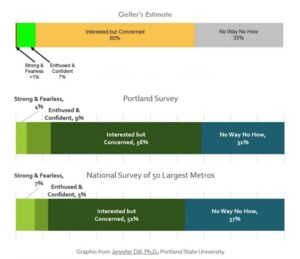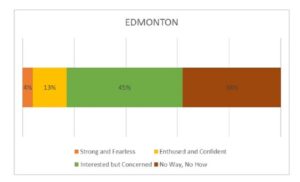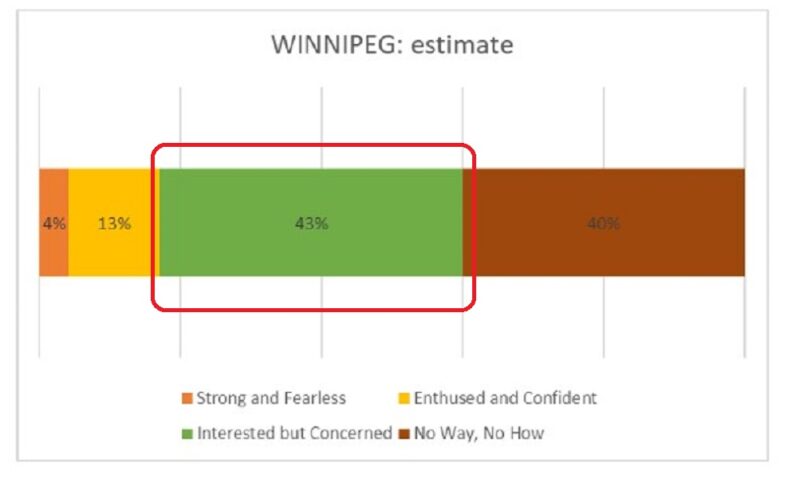


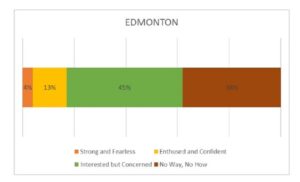

And, according to our numbers, we have around 20% of Winnipeggers travelling by bike for some or all of their trips currently, which is well above the 17% that we should have based on our lack of a complete, safe biking network. It appears Winnipeggers are REALLY enthused!
So, the next time you’re part of a traffic jam, take a moment to look around. Remember that in our city, only about 40% of folks want to drive no matter what, while 80% of folks are driving for almost everything. Imagine if half of the vehicles around you just … disappeared. Imagine if those folks, instead of having “no choice” but to drive, could choose something else.
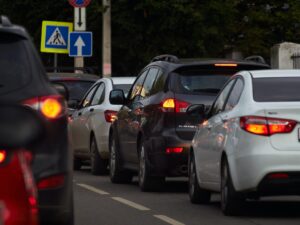
The next time you’re sitting in traffic, imagine if half the vehicles around you … disappeared.
Infrastructure is not pie
One thing we often forget to stress in sustainable transportation advocacy is how awesome good transit and proper walking and biking infrastructure would be for folks who currently drive. But fear not, those who will not change from driving, this is not a zero sum game!
If your city is spending more on transit/walking/biking, that does not mean YOUR driving trip is going to get worse. It’s actually going to get a whole lot better. It’s weird, it’s hard to wrap our brains around, but it’s true. You may love your vehicle but, be honest, when you’re in congestion, you HATE everyone else’s.
The next time you hear about money spent on transit or a bike lane, even if you are never going to use that bus or bike lane yourself, you are not losing. Your share of the pie is not getting smaller. More efficiency means there’s literally more pie for everyone.
Types of Riders
You might be starting to think I have a point, but I completely understand your worry. A person going from driving every day for almost everything is a LONG way from being an all-weather bike rider. It’s not impossible, but it’s improbable.
The People on the Bus
A similar way of analyzing transit is emerging in cities, which will help guide us to making impactful system changes.
For a long time we’ve talked about people on the bus being Choice riders or Captive riders. Choice riders are wealthier and have the option to drive, but might choose to take transit, while the Captive riders are poorer, less likely to own a personal vehicle and therefore compelled to take the bus. Cities, because of this, have spent many years and a lot of money trying to attract those Choice riders with fancy things like wifi on buses or switching from buses to light rail. As a result, they’ve left the captive riders with the infrequent, overcrowded buses they have. “No need to worry about them, they’re captives.”
Needless to say, these labels and strategies haven’t done a lot to improve transit in our cities to move people from driving alone to taking public transportation. Jarrett Walker wrote a great article on this called The Dangers of Elite Projection. (If you’ve ever thought about having cell phone chargers at bus stops, please read ASAP.)
Thankfully, new research is emerging and it’s summarized on StreetsBlog:
“Regardless of whether transit riders own a car, what actually matters to them aren’t the bells and whistles, or even the type of vehicle, but the basics: service they can depend on to get places on time.
“Transit has to compete for every rider,” Higashide told Streetsblog. “There’s often this assumption that people without cars have no choice, have to ride transit. People are sensitive to transit quality regardless of car ownership.” (The “Choice” vs. “Captive” Transit Rider Dichotomy Is All Wrong, Angie Schmidt)
How should we define the different types of riders?
TransitCenter suggests looking at the types of trips they use it for:
- “Occasional riders” only use transit for unusual trips.
- “Commuters” use it to travel to work but not for many other journeys.
- “All-purpose riders” take transit to work, to do errands, and for a variety of trips.
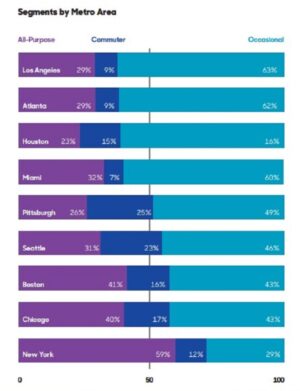
TransitCenter surveyed households across America to break down the numbers in each type (see graph below).
If you’ve done any traveling across America, you know you can spend weeks in New York without thinking about renting a car or taking a cab. On the other hand, no one talks about a great LA vacation car-free.
In 2019, in Winnipeg, transit accounted for 8.5% of trips, but I’m unsure how that would break down by Occasional vs Commuter vs All Purpose. I’d be inclined to assume that we have a very low percentage of All-Purpose riders, as our system was designed around 9-5 office workers going downtown Monday to Friday. This means we have an incredible opportunity to shift more trips from personal vehicles to transit through investment in frequent, quality transit for a diverse ridership.
Best of all, we already have a Transit Master Plan that aims to do just that. All we have to do is fund it in time for more people to take advantage of it now, as opposed to in the year 2050 or so.
What to do
We can see cities around the world shifting their focus from making vehicle travel convenient, to prioritizing the safety and comfort of those taking the bus, riding their bike or walking to nearby destinations. Whether it’s Norway’s push for more bikes, China’s license plate lottery to limit cars, buses in Bogota, or Paris’ transportation revolution, there are many examples we can learn from across the globe.
We know that Winnipeg can have similar results if we focus on making these changes here too. One thing we don’t have to worry about is convincing Winnipeggers to drive less. We know they already want to, we just have to give them that choice.
(click here for a larger version of the graph below)
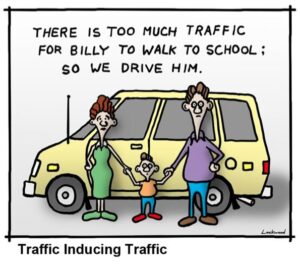
(click here for a larger version of the cartoon below)